
Building AI Avatars That Scale
Multiply Your Digital Presence, Create AI-Powered Content, and Turn Virtual Avatars Into Business Growth Opportunities
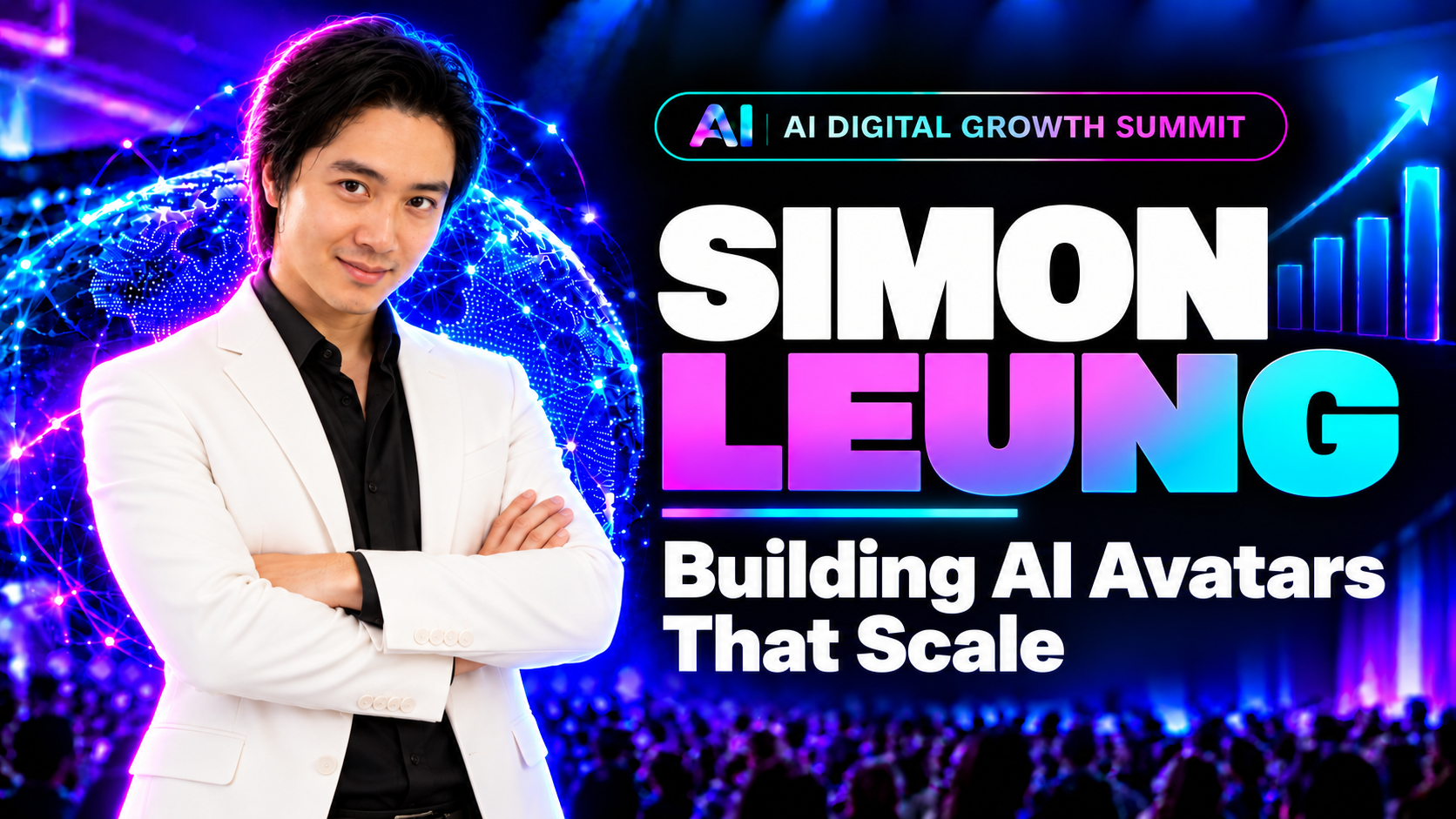
Veteran internet marketer Simon Leung explores how AI is changing personal branding, social media marketing, and online entrepreneurship through AI avatars, digital clones, and a live image-to-video demonstration using Google Gemini and Google Vids.
Session Overview
What if you could create a digital version of yourself that promotes your business, produces engaging content, and helps you reach new audiences without constantly being in front of a camera? In Building AI Avatars That Scale, veteran internet marketer Simon Leung explores how artificial intelligence is changing personal branding, social media marketing, and online entrepreneurship. Drawing on his internet marketing experience dating back to 1997, Simon introduces what he calls the AI clone revolution. He explains the difference between an avatar that simply resembles a person and a more advanced AI clone designed to support content production, communication, and business automation. Through examples of AI-generated lifestyle videos, product promotions, animated characters, and digital influencers, Simon demonstrates how entrepreneurs can use AI to create content across a range of industries. The session includes a live demonstration using Google's Gemini to transform an ordinary photograph into a cinematic promotional image for the AI Digital Growth Summit. When his initial video-generation attempt encounters limitations, Simon moves to Google Vids and demonstrates how an AI-generated image can become an animated promotional video. Beyond visual content creation, Simon discusses potential business applications, including affiliate marketing, e-commerce promotion, personal branding, agency services, and lead generation. Attendees will learn how AI-generated characters can reduce traditional production barriers, expand creative possibilities, and become part of a repeatable marketing strategy. The central message is that creating impressive AI content is only the beginning. Entrepreneurs must connect that content to distribution, audience development, and monetization to produce meaningful business results.
Key Takeaways
- AI is creating opportunities to multiply human output. Simon frames AI as a way to extend an entrepreneur's presence and automate tasks that previously required hands-on work.
- An AI avatar and an AI clone are not necessarily the same thing. In Simon's framing, an avatar provides the visual appearance, while a clone includes the systems and automation behind that appearance.
- AI can reduce the need for traditional video production. Simon demonstrates content created without filming live scenes, organizing physical locations, or producing elaborate sets.
- Personal branding can extend beyond a literal digital twin. Entrepreneurs can create realistic portraits, stylized characters, animated figures, or fictional personas.
- One identity can support multiple content formats. His showcase includes travel imagery, product demonstrations, cinematic scenes, entertainment, and promotional content.
Transcript
Full searchable transcript of this session. Read along or jump to any moment with timestamped paragraphs.
Resources
- Watch the SessionFull AI Digital Growth Summit presentation
- Read the TranscriptEditorial session summary — full transcript coming soon
- AI Clones Insider SecretsPaid program Simon describes — copy-and-paste prompts, a live three-day training, recordings, community access, and group coaching. The $497 price and bonuses were event-specific offers and are not confirmed as currently available.
- Promotional Image PromptAn AI-generated cinematic promotional prompt adapted from Simon's demonstrated Gemini prompt. A reconstructed version, not a verbatim reproduction of a complete on-screen prompt.
- Simon Leung on FacebookSimon directs attendees to his Facebook profile to request the prompts used to create his AI promotional banner. The spoken URL has inconsistent transcriptions, so the intended profile should be confirmed.
All Key Takeaways
AI is creating opportunities to multiply human output
Simon frames AI as a way to extend an entrepreneur's presence and automate tasks that previously required hands-on work.
An AI avatar and an AI clone are not necessarily the same thing
In Simon's framing, an avatar provides the visual appearance, while a clone includes the systems and automation behind that appearance.
AI can reduce the need for traditional video production
Simon demonstrates content created without filming live scenes, organizing physical locations, or producing elaborate sets.
Personal branding can extend beyond a literal digital twin
Entrepreneurs can create realistic portraits, stylized characters, animated figures, or fictional personas.
One identity can support multiple content formats
His showcase includes travel imagery, product demonstrations, cinematic scenes, entertainment, and promotional content.
Visual engagement is not the same as revenue
Simon distinguishes content designed to attract attention from the lead generation and sales activities that follow.
AI-generated creators can participate in established creator-economy models
Simon presents examples of AI-related channels and discusses the potential for content-driven revenue.
Business owners do not always need to use their real identities
Animated characters, virtual personalities, and mascots can function as branded content presenters.
Technical complexity often prevents consistent content creation
Simon identifies time, equipment, expertise, software, and production demands as common obstacles.
Accessible AI tools lower the barrier to experimentation
He demonstrates image creation with Gemini and identifies other AI assistants available to entrepreneurs.
Reference images help anchor an AI-generated identity
His demonstration begins with uploading an existing photograph and describing the intended appearance and setting.
Prompt specificity influences creative output
Simon specifies lighting, visual style, realism, scene, and promotional purpose in his example prompt.
AI workflows require experimentation and troubleshooting
When his first video-generation attempt fails, he switches to another Google tool to continue the demonstration.
Consistent publishing is part of audience development
Simon emphasizes daily social posting as a major contributor to his content strategy.
Monetization should be designed into the AI content strategy
Simon discusses using avatars for agency services, affiliate promotions, e-commerce, event marketing, and lead generation.
What You'll Learn
Multiply Your Digital Presence
Understand how AI avatars and clones can help entrepreneurs produce content without appearing on camera for every video.
Create Cinematic AI Content
Discover how to transform a reference photograph into branded imagery using AI prompts and image-generation tools.
Turn Images Into Videos
Explore the image-to-video workflow demonstrated with Gemini and Google Vids.
Promote Products and Services
Explore AI avatars for e-commerce, affiliate offers, events, and social media campaigns.
Explore Monetization Models
Learn how Simon connects AI-generated content with potential advertising, affiliate, and agency revenue.
Build Content Consistency
Understand why regular publishing and an efficient production process matter for audience growth.
Creating impressive AI content is only the beginning. Connect it to distribution, audience development, and monetization to produce meaningful business results.
An avatar provides the visual appearance. A clone includes the systems and automation behind that appearance.
Frameworks From This Session
Avatar vs. Clone
- 1AI Avatar — a visual identity; a recognizable face or digital character used in generated content
- 2AI Clone — identity plus systems; Simon's broader concept of a digital representation supported by knowledge, content, and business automation
- 3The distinction is conceptual — the live demonstration creates images and videos, and does not establish a fully autonomous business-operating clone
Reference-Photo-to-Video Workflow
- 1Select a reference photo — choose the person or character you want represented
- 2Write the creative prompt — specify the scene, lighting, style, subject, and promotional objective
- 3Generate the image with Gemini — review the AI-created promotional portrait
- 4Animate with a compatible tool — Simon uses Google Vids after the initial generation attempt is declined
- 5Use as promotional content — apply the finished video to an event, brand, or business campaign
Content-to-Revenue Pathway
- 1Generate attention-worthy visual content with AI
- 2Distribute consistently across social platforms
- 3Develop an audience through regular publishing
- 4Connect content to monetization — agency services, affiliate promotions, e-commerce, event marketing, and lead generation
- 5Note: the session discusses promotion and monetization, but does not provide a complete sales funnel architecture or measured conversion benchmarks
Tools Mentioned
The tools matter less than the workflow — these are the ones referenced in this session.
Google Gemini
Live AI promotional-image creation demonstrated during the session. Simon uses it to transform a reference photo into a cinematic promotional portrait.
Google Vids
AI video generation and animation demonstration. Simon switches to Google Vids after his initial video-generation attempt is declined.
ChatGPT
Named as an alternative AI assistant and content-generation platform. Not demonstrated as an integration.
Claude
Mentioned as an alternative AI assistant. A contextual mention, not a tool demonstration.
Microsoft Copilot
Mentioned as an alternative AI assistant available to entrepreneurs.
HeyGen
Discussed in the closing conversation as an avatar-generation platform.
ElevenLabs
Mentioned as an AI content-creation tool.
Named for personal branding, publishing, and access to Simon's prompt guide. The spoken URL has inconsistent transcriptions and should be confirmed.
YouTube · TikTok
Content distribution and creator-monetization examples referenced during the session.
Ask About Simon's Session
Have a question about AI avatars, digital clones, personal branding, image-to-video workflows, content monetization, or using AI to produce content without appearing on camera? Ask the Summit AI and get an answer grounded in Simon's session and related expert presentations.
Related Sessions
AI for International Real Estate
Why it's related: Krystal discusses using AI avatars as part of multilingual property tours and buyer engagement. Simon goes deeper into creating AI avatars and digital clones at scale.
AI-Powered Video Content That Builds Authority and Sells
Why it's related: Lou focuses on using video and AI avatars selectively to build authority and trust. Simon expands the content-creation side into scalable AI-generated visual content and monetization.
Moving From Prompts to AI Employees

Why it's related: Robyn extends AI into employees, agents, roles, and organizational workflows. Simon's clone concept — identity plus systems — pairs naturally with that operating-layer thinking.
Content & Organic Growth

Why it's related: Deven captures attention through organic content and builds an AI second brain from institutional knowledge. Simon shows how AI-generated avatars can become part of that repeatable content engine.
About the Speaker
Simon Leung
Simon Leung is a veteran internet marketer and entrepreneur who helps business owners explore AI-powered personal branding, content production, and online monetization. Originally from Hong Kong, he moved to the United States at age five and later relocated to Malaysia. He reports beginning his internet marketing career in 1997 and previously working at Google, where he says he contributed to optimization work and global algorithms. His experience spans internet marketing, entrepreneurship, consulting, coaching, and online business development. At the AI Digital Growth Summit, Simon shares his approach to creating AI avatars and digital clones that allow entrepreneurs to produce engaging visual content without traditional filming requirements — and emphasizes connecting that content to distribution, audience development, and monetization. This bio is based on Simon's self-reported background in the session write-up; his Google employment details have not been independently verified.
Speaker-Reported Business Examples
Figures reported by the speaker during the presentation; labeled internally as speaker-reported rather than independently verified.